

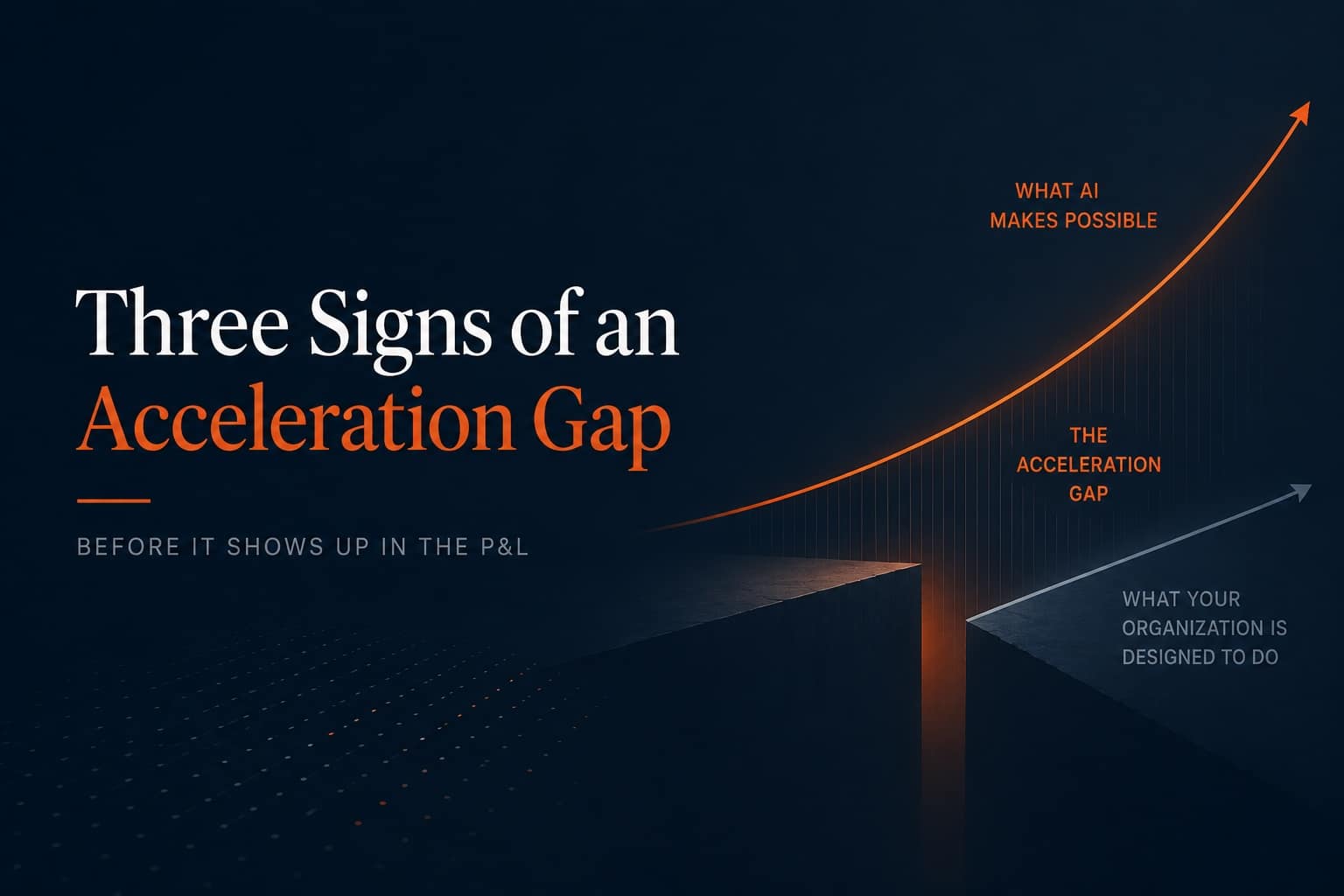
Three Signs You Have an Acceleration Gap (Before It Shows Up in the P&L)
By the time an AI strategy problem shows up in the P&L, the gap has already been widening for months.
That delay is not incidental. The Acceleration Gap — the distance between how fast an organization can move and how well its systems are designed to support movement — does not announce itself through financial underperformance. It announces itself through friction: decisions that take longer than they should, pilots that succeed without scaling, and leadership conversations that feel aligned until they’re operational.
AI is not just a tool shift. It is a systems shift — one that tests leadership alignment, governance architecture, and workflow design simultaneously. McKinsey’s research on generative AI found that more than 80% of respondents reported no tangible enterprise-wide EBIT impact despite widespread adoption, while workflow redesign was the single strongest predictor of positive EBIT impact. Most organizations are moving. Not many are actually changing.
Three signs appear before the P&L moves. Each one points to a different place to inspect first.
Everyone Is “Aligned,” but Teams Define the Strategy Differently
The first sign is not open disagreement. It is polite agreement followed by inconsistent interpretation.
Ask senior leaders to describe the organization’s AI strategy in a sentence. Most will say something coherent. Then ask a harder question: what is the organization explicitly not doing with AI right now, and why? The answers will diverge quickly. When functions reinterpret priorities based on their own pressures — and when no one has articulated what success means specifically enough to produce consistent decisions — alignment is vocabulary, not structure.
Corporate Finance Institute’s synthesis of Kaplan and Norton’s research found that only 5% of employees understand their company’s strategy. That gap makes every layer of day-to-day decision-making vulnerable to drift. At the leadership level, this shows up before anything reaches frontline teams. Executives who agree in principle but disagree on definition will resource AI initiatives against five different criteria simultaneously.
If every team can make the AI strategy sound reasonable in a different way, the organization does not have alignment. It has translation risk.
Ask each member of the leadership team, separately, to name one thing the organization has explicitly decided not to do with AI right now, and why. If the answers are consistent, alignment is real. If they aren’t, the strategy hasn’t been defined at the level that governs actual decisions.
Governance Shows Up After the Decision, Not Before It
The second sign is decision friction. New tools move faster than the operating model built to guide them.
This pattern is easy to recognize in retrospect and nearly invisible in the moment. Data use policies get clarified after a tool is already in production. Legal, security, product, and business teams discover they have different working assumptions about ownership when a decision is contested. Governance is experienced as a blocker — something that slows adoption down — rather than as the structure that makes acceleration possible.
McKinsey found that CEO oversight of AI governance was one of the factors most strongly correlated with higher self-reported bottom-line impact from generative AI, particularly in larger organizations. The correlation is not coincidental. When governance has executive ownership and is built before adoption scales, it answers questions preemptively rather than adjudicating disputes after the fact.
Good governance creates safe speed, not bureaucratic drag. The test is whether the framework answers the operational questions specifically enough that teams can act without waiting for a one-off determination on every edge case.
If governance only appears when something is contested, the organization is already behind the speed of the tools it has adopted.
Identify the last three AI-related decisions that required escalation or generated cross-functional debate. Were the resolution criteria clear before the decision arose, or were they developed in response to the conflict? The answer describes the current state of governance design.
AI Activity Is Increasing, but the Work Is Not Actually Changing
The third sign is visible activity without integration.
AI tools live in pilots, side projects, and individual productivity habits. Leaders can report usage numbers — seat licenses, active users, hours logged — but cannot trace a change in a business outcome. A pilot that succeeded has no clear path to scale. Teams are permitted to use AI but not told how they are expected to use it.
McKinsey found that fewer than one in five organizations were tracking KPIs for their generative AI solutions — even though KPI tracking was the adoption practice most strongly associated with positive bottom-line impact. BCG’s research adds a structural dimension: more than 75% of leaders and managers use generative AI several times a week, while frontline employee usage has stalled at 51%, and only one in three employees report being properly trained.
That gap is not a training problem. It is a systems problem. When the incentive structure of a role rewards consistency and penalizes error, keeping the tool at arm’s length is the rational response — not resistance.
Addressing it requires changing what gets measured and rewarded, not running another workshop. The question is not whether people are using AI. The question is whether the operating system of the company has changed.
Pick one workflow where AI tools are actively in use. Map it step by step and identify where AI output enters a human decision. If the handoff is inconsistent, optional, or invisible to the process owner, the tool is running parallel to the work — not integrated into it.
Diagnose the gap before it compounds
Three Early Signals. One Common Structure.
Different definitions of the strategy. Decision rights that appear too late. Activity that does not change workflows or outcomes.
None of these surface in the P&L first. They surface as friction — persistent, low-grade, and easy to misattribute to execution, culture, or change fatigue. The acceleration is real. The systems were not designed to absorb it.
Friction does not come from innovation itself. It comes from misalignment between the pace of change and the structures built to govern it. That gap is diagnosable before it becomes expensive.
Take the Acceleration Gap Diagnostic →