
Shadow AI, Fast-Moving Risk, and Your Board’s Blind Spot
MIT’s Project NANDA documented a gap worth understanding: while only 40% of companies have purchased official AI subscriptions, employees at more than 90% of organizations regularly use personal AI tools for work. A 2025 WalkMe survey found 78% of employees already bring their own AI to work.
The gap between authorized and actual is Shadow AI — the use of AI tools outside official channels, without IT oversight or policy coverage. It isn’t a sign of rogue teams. It’s a governance signal.
Shadow AI Is a Structural Symptom, Not a Discipline Problem
When AI tools are cheap, frictionless, and available to anyone with a browser, IT-gated adoption breaks down. That’s not an opinion — it’s a design reality.
Research from Sweep.io found that the top reasons workers use unauthorized AI tools are direct: they’re faster (41%), they produce better results (33%), and official tools don’t meet their needs (32%). Only 13% say they didn’t know the tools weren’t approved.
Most employees know the rules. They’re choosing speed over compliance anyway — not because they’re reckless, but because the governance structure wasn’t designed for the pace at which AI tools have become available. That’s a structural mismatch, not a culture problem.
Speed without structure is just debt.
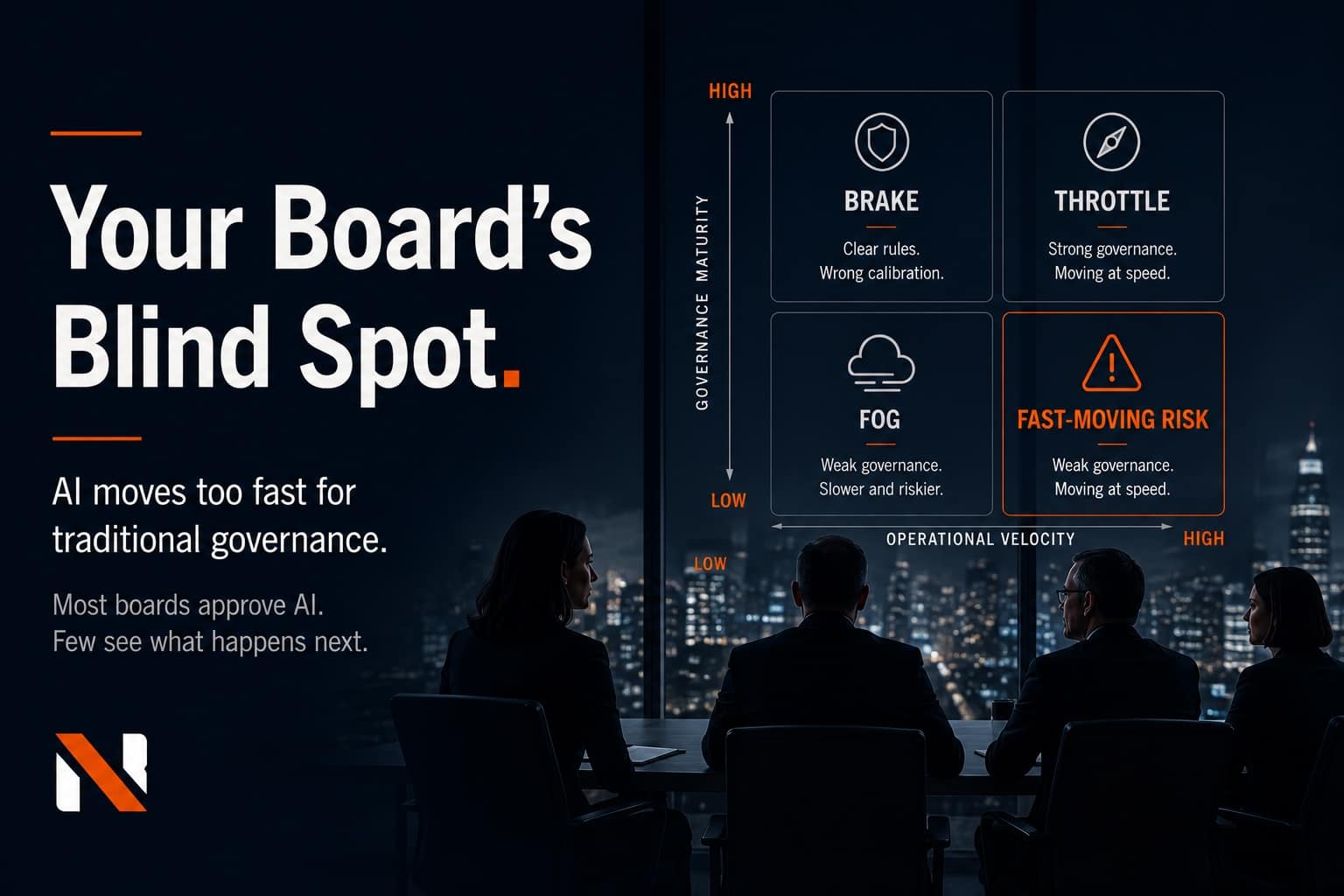
When Shadow AI is widespread in an organization, it almost always signals that AI adoption has outpaced governance clarity. Northline maps this as Fast-Moving Risk — a specific position on the Governance Readiness Map where adoption velocity is high and governance design hasn’t kept up. The energy is there. The guardrails aren’t. That gap is where the real exposure lives.
The Question Boards Should Be Asking — and Aren’t
Most boards approach AI risk by asking about policy. The CISO points to it. The IT team confirms it exists. The conversation moves on.
That’s the wrong question. A policy describes what was authorized. It says almost nothing about what’s actually happening.
The risk isn’t in the approved system. It’s in the 665 others running in parallel.
And here’s what most boards miss: this isn’t a frontline problem. The 2025 Deloitte AI Governance Global Survey found that 41% of senior executives have personally used an unsanctioned AI tool for work in the past 90 days. Shadow AI is a leadership accountability problem before it’s a compliance one.
Boards receive risk reports built around what was authorized. The exposure lives in what’s actually running.
Traditional oversight frameworks — SOX, ISO, NIST — weren’t built for this velocity. Enterprise software used to require procurement, IT deployment, and user training. An AI tool can be running inside someone’s workflow in under ten minutes. The oversight structure hasn’t been redesigned to match what’s actually operating.
Fast-Moving Risk — A Quadrant, Not a Crisis
Before responding to Shadow AI patterns, it helps to know exactly where your organization sits. The Governance Readiness Map places leadership teams in one of four positions based on adoption speed and governance clarity.
Most organizations with visible Shadow AI patterns sit in Fast-Moving Risk. It’s worth being precise about what that means — because it is not the same as a crisis.
In the Fog, teams are uncertain and stalled. In Fast-Moving Risk, teams are capable and moving. That’s a meaningfully better starting position than it appears, because the organizational energy is already there. The governance work is catching up to adoption, not building adoption from scratch.
What Fast-Moving Risk requires is not a policy document. It requires a clear map of the gap, followed by one specific governance move in the next 30 days. Not a six-month policy rewrite. One move.
Three Governance Moves for Fast-Moving Risk
Map Before You Mandate
Before issuing new policy or sending a compliance memo, spend two weeks on a lightweight audit of where AI is actually being used. Survey managers. Ask teams directly. You’ll find more than you expect — and you’ll find it distributed in ways that matter for how you respond.
A mandate without a map is governance theater. It creates the appearance of oversight without the structure behind it.
Separate Speed from Exposure
Not all unsanctioned AI use carries equal risk. A team using AI to draft internal meeting summaries is a different problem than a team routing customer data through an unconfigured third-party model. Conflating them produces blanket restrictions that reduce productivity without addressing actual exposure.
Build a simple tier: Low / Medium / High based on data sensitivity and regulatory context. Act on High first. Let Low continue while you build toward a more comprehensive framework.
Run the Governance Readiness Map
If leadership doesn’t have a shared picture of where AI adoption stands relative to governance clarity, that’s the first thing to establish. The Map surfaces exactly that — the gap between adoption speed and governance design, and which single move will close it fastest in the next 30 days. It takes approximately 45 minutes. It replaces months of internal guessing.
The Board’s Actual Responsibility
Shadow AI is not a sign that teams have gone rogue. It’s a sign that AI has moved faster than the organization’s design. That’s a solvable problem — but only from a position of clarity.
Most boards are still governing the version of AI that existed two years ago: expensive, specialized, and visible to traditional monitoring systems. The version operating in most organizations today is cheap, personal, and invisible to those same systems. The oversight structure hasn’t been redesigned to match.
The risk isn’t in the approved system. It’s in the hundreds of others running in parallel. The first step is knowing where you actually are.
Run the Governance Readiness Map
A Clear Picture of Where You Stand. One Move to Close the Gap.
The Map gives you a precise view of where your organization sits on adoption speed and governance clarity — and identifies the single governance move most likely to close the gap in the next 30 days.
It takes six minutes. It replaces months of internal guessing.
- MIT Project NANDA, State of AI in Business 2025
- WalkMe, Employees Left Behind in Workplace AI Boom, 2025
- Sweep.io, The Big AI at Work Study 2025
- KPMG, Trust, Attitudes and Use of AI: A Global Study 2025
- Harmonic Security, What 22 Million Enterprise AI Prompts Reveal About Shadow AI
- Deloitte, Governance of AI: A Critical Imperative for Today’s Boards, 2025