

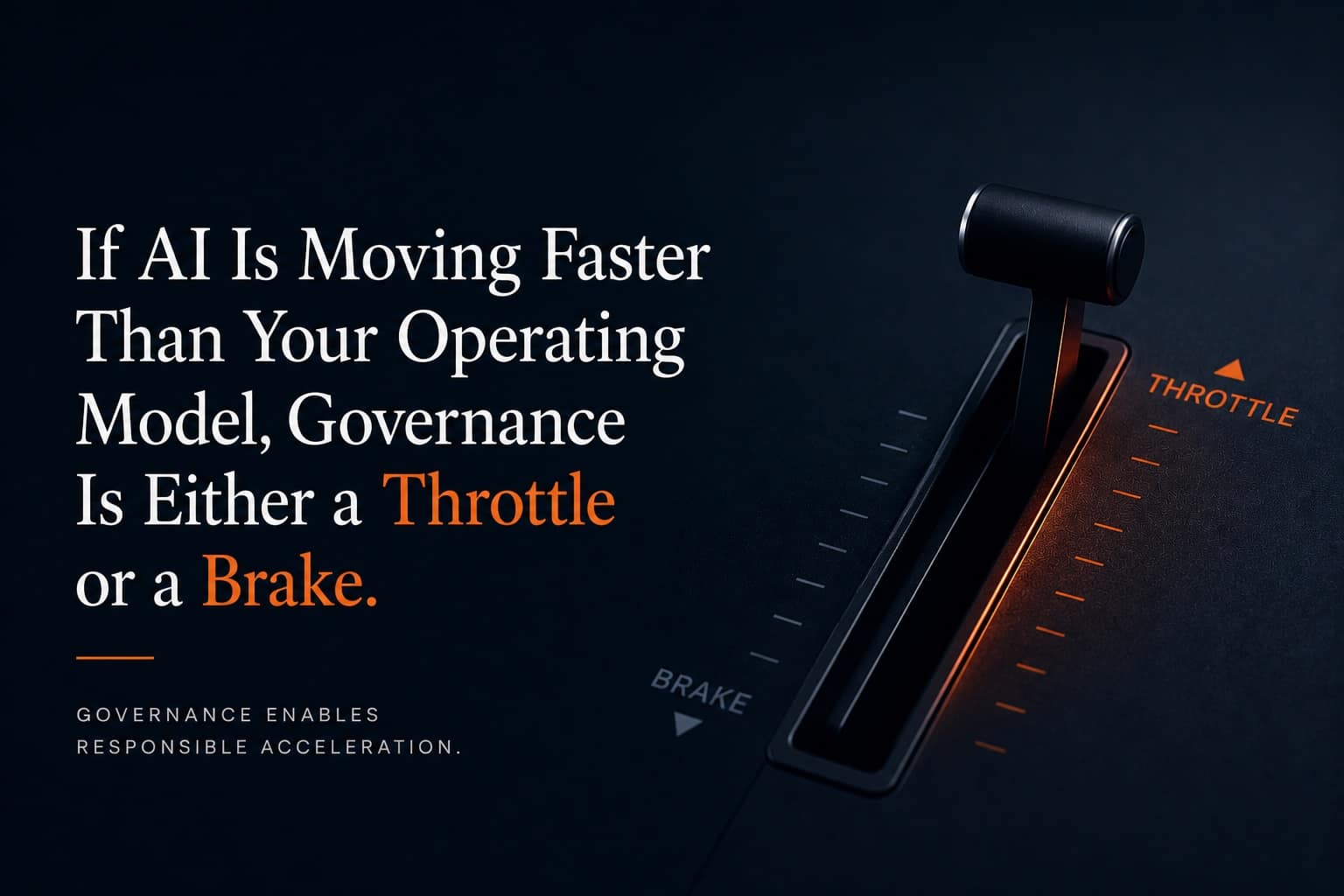
If AI Is Moving Faster Than Your Operating Model, Governance Is Either a Throttle or a Brake
Most executive teams think they have an AI problem. What they actually have is a structural one.
AI capability is accelerating exponentially. Organizational systems — decision rights, governance, accountability — evolve linearly. That widening distance is the Acceleration Gap: the space where friction compounds, priorities drift, and organizations begin reacting instead of designing. Once you’re in reactive mode, the cost of every decision compounds — because you’re not just solving the problem in front of you, you’re also compensating for the structure you never built.
The Acceleration Gap doesn’t announce itself. It shows up gradually, in small signs: a pilot that stalls before it scales, a cross-functional disagreement that has no clean resolution path, a compliance concern raised six months after adoption. By the time it’s visible, the gap is already wide.
If AI is moving faster than your operating model, governance becomes the deciding variable. And governance only behaves in one of two ways.
Governance Is Not the Opposite of Speed. It’s the Shape of It.
Most leaders hear “governance” and imagine slower approvals, more oversight, and another layer of drag. That association isn’t wrong — it’s just based on the wrong version of governance.
The governance most organizations actually have was written under pressure. A security scare surfaced a gap. Shadow AI usage created legal exposure. A near-miss with reputational risk prompted a policy. In each case, governance arrived after the fact — reactive, defensive, and scoped to prevent the specific harm that just occurred. Ownership became fuzzy. Restrictions multiplied without proportionality to actual risk. Teams learned to route around the process, because the process was built to stop things, not enable them.
That is retrofitted governance. Governance as a brake.
Designed governance works differently. Decision rights are clarified before they’re contested. Guardrails are proportioned to actual risk appetite — not calibrated to the worst-case scenario. Escalation paths are defined and short, so edge cases get resolved quickly instead of dying in committee queues. Teams know what they can do without asking for permission, and what they need to escalate without ambiguity.
Governance is not the opposite of speed. It’s the shape of it.
This is governance as a throttle: a system that modulates motion rather than preventing it. The structure doesn’t slow the organization — it’s what allows the organization to move faster without accumulating hidden risk.
Why Governance Breaks Before Strategy Does
The first sign of the Acceleration Gap is rarely a failed technology. The technology often works. What breaks is the operating layer around it.
It looks like teams experimenting faster than leadership can align. Legal, security, and operations disagreeing — not about the technology, but about who owns the decision. AI adoption happening across the organization without agreed guardrails. Successful pilots that produce real results and then stall, because no operating structure exists to carry them to scale.
This is the pattern we see most consistently: enthusiasm mistaken for alignment, governance that arrives after adoption rather than before it, and pilots that never become infrastructure. Each stage is predictable, and each one is avoidable.
Organizations do not lose coherence because they moved too quickly. They lose coherence because their systems were not designed to carry the speed.
The Acceleration Gap is not a technology problem. It’s a design problem — and governance is the first place it becomes visible.
Four Ways Governance Quietly Shapes Speed
Most leaders don’t realize whether governance is helping or hurting until friction becomes visible. By then, the workarounds are already established, and changing behavior requires more organizational effort than building the structure correctly would have.
That’s the purpose of the Governance Readiness Map: a diagnostic that pressure-tests whether your operating model enables responsible acceleration — or quietly blocks it. It scores across four dimensions.
Where Are You Operating Today?
The Governance Readiness Map places your organization in one of four quadrants, defined by two axes: how clear your decision rights and guardrails are, and how proportioned they are to your actual risk appetite.
The Question Is Not Whether You Have Governance
Every organization already has governance. Some version of decision rights, some tolerance for risk, some process for escalation — even if none of it was ever explicitly designed. The question is whether it was built intentionally, or whether it accumulated accidentally in the wake of adoption.
If AI capability is moving faster than your operating model, governance will shape what happens next. It will either absorb speed. Or quietly block it.
The organizations that build real AI advantage over the next three years won’t be the ones that moved fastest. They’ll be the ones whose operating models were designed to carry the speed they were moving at.
Plot yourself on the readiness map
Governance Will Shape What Happens Next. Design It Before It Designs Itself.
The Governance Readiness Map is a six-minute executive diagnostic that measures whether your governance is enabling responsible acceleration — or quietly becoming a brake. It scores across the four dimensions above and places your organization in one of four quadrants, with a specific first move from wherever you land.
If the map surfaces something worth talking through, we offer a 30-minute discovery call — no pitch, just a conversation about where your governance is actually sitting and the single move most likely to raise your quadrant.