

Most enterprise AI programs share the same arc: a funded pilot, a credible early win, an internal case study — and then, silence. The tool stays in active use by the original team. It never scales. Six months later, leadership is debating the next wave of capabilities, and the organization is still running the same workflows it ran before the pilot launched.
This is not a technology problem. The technology worked. The organization didn’t.
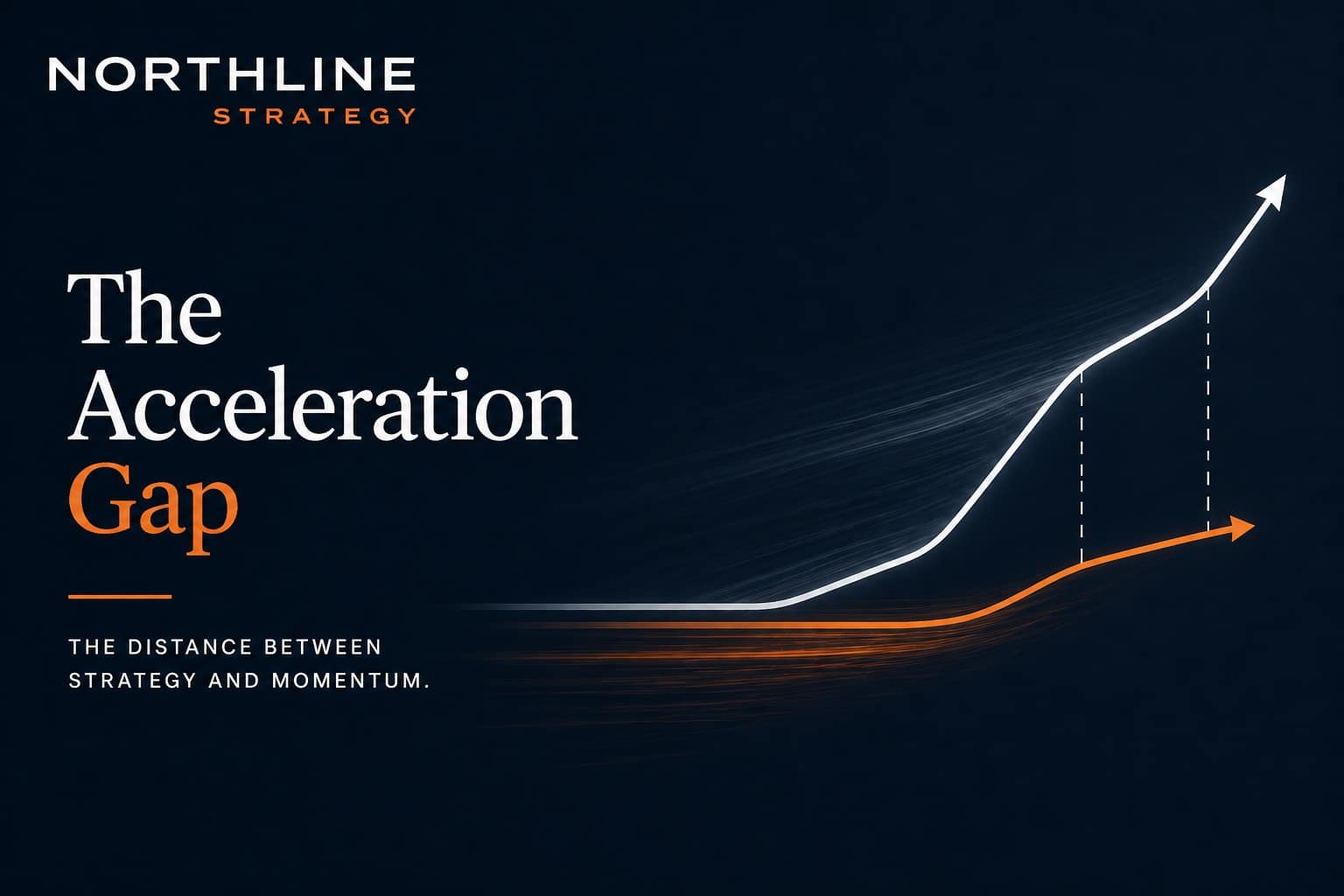
The distance between what AI makes possible and what organizations are actually structured to do is what we call the Acceleration Gap. It’s not a question of access — most enterprises have access to more capability than they’re using. The constraint has shifted entirely to absorptive capacity: the ability to actually redesign work around new tools, at the pace those tools arrive.
Understanding why this gap widens, where it shows up operationally, and what it actually takes to close it is the difference between leading a capability shift and documenting it from the sidelines.
Capability Has Been Commoditized. Readiness Hasn’t.
Twelve months ago, deploying an enterprise-grade LLM for document analysis, contract review, or customer interaction required meaningful technical investment. Today, that same capability is available off-the-shelf, configurable by a reasonably technical product manager, and priced at a fraction of what custom development would have cost.
This is not a problem — it’s the point. The competitive bottleneck is no longer access. It’s the speed at which an organization can redesign itself to use what’s available.
Most organizations haven’t caught up to that shift. They’re still treating AI adoption as primarily a technology procurement question — which tool, which vendor, which security review — when the harder question is structural: does this organization’s decision-making architecture, governance model, and talent incentive structure allow it to change the way work actually happens? For most, the answer is no, and nobody has said so explicitly.
That’s what the Acceleration Gap actually measures: not technological lag, but organizational lag.
Four Places the Gap Shows Up Before Anyone Calls It a Problem
The Acceleration Gap doesn’t surface as a single failure. It shows up as friction — small, persistent, and often misdiagnosed as a training issue or a change management issue or a tool selection issue. Here’s what it looks like in practice.
Leadership is aligned on intent but not on definition. Ask five senior leaders what your AI strategy means operationally, and you’ll get five different answers. One is thinking about efficiency gains. Another is focused on competitive differentiation. A third is in risk-management mode. A fourth hasn’t fully separated AI capability from AI risk in their mental model. None of them are wrong — but without a shared operational definition of what “successful adoption” looks like, resourcing decisions get made against five different criteria simultaneously. That’s how well-funded initiatives stall at the pilot stage.
Governance is written after tools are already in use. In most organizations, the policy team learns about a new AI deployment the same way the rest of the company does — through a Slack announcement or a department all-hands. The result is that governance gets written reactively, documenting what’s already happening rather than establishing a framework for what should happen. In regulated industries, this creates real exposure. In non-regulated ones, it creates inconsistency — some teams using AI in ways that create liability, others avoiding it entirely because nobody has clarified what’s permitted. Both outcomes have a cost.
Tool adoption happens without workflow redesign. A new capability gets introduced. People use it when they remember to. The underlying workflow — the sequence of decisions, handoffs, reviews, and approvals that governs how work actually moves — stays intact. The result is that AI becomes a parallel track rather than an integrated one, and the efficiency gains remain localized to individual users rather than captured at the process level. This is pilot purgatory: the tool works, the pilot metrics look fine, but the organization doesn’t change.
Cultural hesitation is rational, not resistant. When the incentive structure of a role rewards consistency and punishes errors, and AI introduces a new source of unpredictable output, the sensible response is to keep it at arm’s length. Most organizations misread this as change resistance and respond with more training. The actual issue is that the risk-reward calculus for early adoption is negative for the people being asked to adopt. Addressing that requires changing what gets measured and rewarded — not running another lunch-and-learn.
In Regulated Industries, the Gap Has Compounding Risk
Organizations in healthcare, financial services, and education face a version of the Acceleration Gap that carries additional stakes — but not for the reasons usually cited.
The common framing is that regulation slows these industries down, and that’s partly true. Accreditation requirements, audit obligations, and data governance constraints create real friction. But the more consequential dynamic is that the existing governance infrastructure was designed for a different risk profile — one where the primary concern was human error or deliberate misconduct, not probabilistic model outputs at scale.
Most institutional compliance frameworks are not equipped to reason about the kinds of failures AI systems produce: confident-sounding errors, inconsistency across similar inputs, outputs that are technically accurate but contextually misleading. Writing a policy that addresses these failure modes while still enabling legitimate use requires a different kind of governance architecture — one that most regulated organizations haven’t built yet.
The institutions navigating this well are not the ones that have suspended their governance instincts. They’re the ones that have treated governance design as a strategic capability rather than a compliance checkbox. When your AI governance framework is robust enough that auditors can examine your deployment and find no concerns, that framework becomes a competitive advantage — because your less-disciplined competitors will eventually have to stop and build what you’ve already built. Governance designed to enable responsible acceleration is a moat. Governance designed purely to avoid liability is a tax.
Three Operational Moves That Actually Close the Gap
Closing the Acceleration Gap is an organizational design problem. That means the moves that close it are organizational, not technological.
Align leadership on the operational definition before scaling adoption. This is not a vision exercise. It’s a specificity exercise. What does it mean, concretely, for AI to succeed in your organization? Which decisions will it inform? Which workflows will it replace? What does a failure case look like, and who is accountable for it? Until your leadership team has worked through those questions together and arrived at shared answers, every adoption initiative will be optimized against a different definition of success. The alignment conversation is harder than a strategy offsite — it requires your leaders to make trade-offs explicit rather than keeping them implicit — but it is the prerequisite to everything else.
Design governance before you need it, not after. Most organizations treat governance as a downstream activity — something that gets formalized once adoption reaches a threshold that triggers compliance concern. The better approach is to treat governance as the first deliverable of any AI initiative. Not a restrictive policy, but a framework that answers three questions: What is permitted? What requires human review? What is prohibited? A framework that answers those questions clearly creates the conditions for faster, more confident adoption — because teams know what they’re allowed to do without waiting for a legal review on every edge case.
Map the workflow before selecting the tool. The question that drives most AI adoption discussions is “what can this tool do?” The question that should drive them is “how does work actually move through this organization, where does it slow down, and what decisions get made with incomplete information?” When you start with the workflow, tool selection becomes a much simpler problem — you’re matching capability to a documented constraint rather than looking for places to apply a technology you’ve already acquired. This also changes the ROI conversation. Workflow-led adoption produces measurable changes in cycle time, error rate, or decision quality. Tool-led adoption produces usage statistics.
The Constraint Is Organizational Design
The organizations that close the Acceleration Gap fastest will not necessarily be the ones with the largest AI budgets or the most sophisticated technical teams. They’ll be the ones whose leadership has made an explicit decision to treat organizational design as a strategic investment — on par with, and prior to, technology investment.
That means funding the governance work. It means building alignment before launching pilots. It means measuring adoption by workflow change, not by seat licenses. And it means being honest about where the gap currently sits — which requires the kind of diagnostic clarity that most organizations are not yet applying to their AI programs.
The technology is not the hard part. It hasn’t been the hard part for a while. The hard part is building an organization that can change the way it works faster than the rate at which new capabilities arrive. That’s the problem the Acceleration Gap names — and it’s the problem worth solving..