

From Pilots to Operating Model: How to Actually Close Your Acceleration Gap
Most enterprises don’t have a scaling problem. They have an operating model problem.
Deloitte’s 2025 State of GenAI survey put a number on it: as many as 80–90% of AI pilots never become the way an organization actually works, even when the underlying technology performs well. The model isn’t the constraint. What happens to the model after the pilot succeeds is.
That’s the Acceleration Gap, applied to the one part of AI adoption most leadership teams haven’t mapped: the distance between a pilot that works and an organization that has actually changed how it operates.
The Pilot Graveyard Isn’t a Technology Problem
Every organization running AI pilots has a version of the same slide: a strong result, a clean demo, a case study circulated internally. Then nothing. The tool stays with the team that built it. Six months later, someone asks what happened to it, and the honest answer is that it’s still running, quietly, exactly where it started.
That’s pilot purgatory. The real graveyard isn’t the pilots that failed — it’s the ones that worked and still never left the room they were built in.
Picture a pilot most leadership teams would recognize: an internal AI copilot, built by one team to speed up drafting, research, or analysis. It performs well. Adoption is high inside that team. Leadership sees the results and asks for it to be rolled out more broadly. A year later, three other teams have built their own versions, none of them talk to each other, and nobody can say who owns the thing or what it’s supposed to produce at scale.
The pilot didn’t fail. It just never became infrastructure.
The Acceleration Gap Is the Distance Between “AI Works Somewhere” and “AI Is How We Work”
Most organizations stall in exactly that gap. AI capability is proven. Organizational design hasn’t caught up.
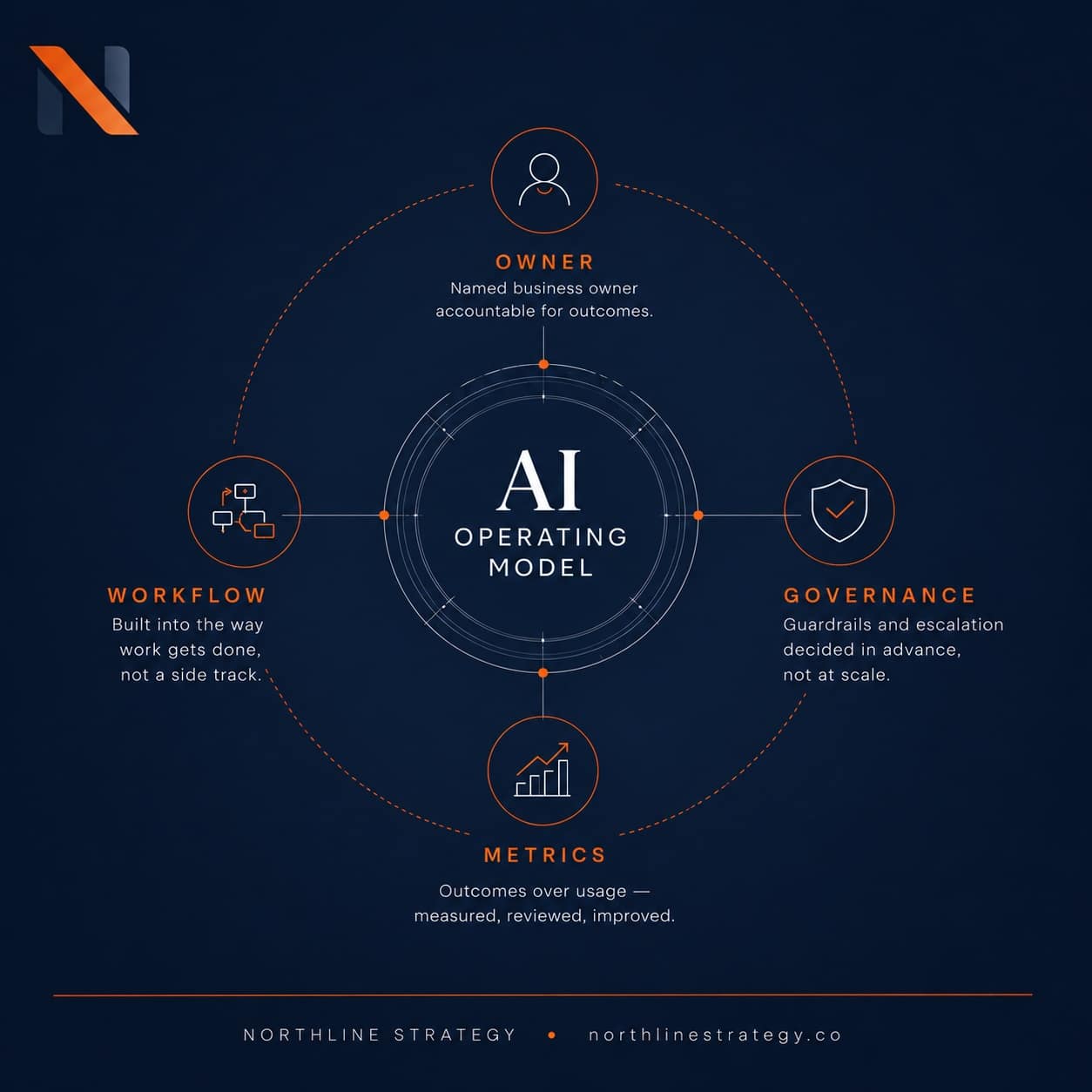
The bottleneck isn’t the model, the vendor, or the tool. It’s the operating model elements that determine whether a proven capability becomes a standard one: ownership, decision rights, workflow integration, governance, and what gets measured. None of those are technology questions. All of them are design questions.
Most organizations invest heavily in proving that AI works. They invest almost nothing in designing the operating model that makes it the way they work. The Acceleration Gap isn’t a technology gap — it’s a design gap.
Why AI Pilots Stall Instead of Becoming the Way You Work
Four patterns show up consistently in organizations with AI pilots stuck in purgatory.
The team that built the pilot has a technical owner. Nobody has assigned a business owner — someone accountable not for how the system works, but for what it produces and what it costs when it doesn’t.
The tool exists as a parallel track: people use it when they remember to, alongside the process it was supposed to change. The underlying workflow — the sequence of decisions, handoffs, and approvals — stays exactly as it was.
Rather than defining risk thresholds and human-in-the-loop rules up front, leadership tables the conversation until the pilot is ready to expand — at which point nobody has answers and the expansion stalls waiting for them.
Leadership can report seat licenses and active users. Nobody can trace the pilot to a change in cycle time, error rate, or revenue. Without outcome-based metrics, there’s no case for further investment — and no way to tell if the pilot is actually working.
These aren’t four separate problems. They’re the missing steps between a pilot and an operating model — the same steps the Acceleration Gap Diagnostic is built to surface.
What an Operating Model Adds That a Pilot Doesn’t
A pilot proves a capability works in a constrained setting. An operating model specifies which decisions AI supports, who owns those decisions, how AI output enters the workflow, how exceptions get handled, and how performance and risk get monitored on an ongoing basis.
The progression looks like this:
A team identifies a decision or workflow where AI could help.
The team proves value in a constrained context, with real data and real users.
Owners, decision rights, data pipelines, integration points, review cadence, and metrics get locked in — so the capability becomes repeatable, not a side project one team happens to maintain.
Most organizations invest heavily in the first two stages and skip the third. That’s the gap.
Five Design Moves That Close the Gap
Closing the gap requires design, not more tools. Five moves, in order of where they matter most:
Assign a business owner and a product owner before scaling past the pilot
Not a team — named people, accountable for outcomes and for the roadmap.
Embed AI into existing systems and workflows
Not a new standalone app running alongside the process — the process itself, changed.
Define governance before you need it
Risk thresholds, human-in-the-loop rules, and an escalation path for when the model is wrong or uncertain — decided in advance, not improvised under pressure.
Set outcome-based metrics
Cycle time, error rate, revenue, satisfaction — tied directly to the decisions AI is supporting. Usage statistics tell you the tool is running. Outcome metrics tell you it’s working.
Build a recurring review ritual
Leaders look at impact, exceptions, and what’s been learned — not just a dashboard. This is where sustain, revise, or sunset decisions get made deliberately instead of by default.
Each of these is a design question the Acceleration Gap Diagnostic is built to surface — which move matters most depends on where your gap currently sits.
One team inside a mid-sized services organization built an internal copilot to speed up first drafts of client-facing analysis. It performed well enough that two other teams asked for access within a quarter.
Before: The copilot lived with the team that built it. There was no named business owner, no defined review process for what it produced, and no metric beyond “people like using it.” When a second team asked to adopt it, there was no path — just an informal handoff of a shared document.
After: Leadership named a business owner accountable for output quality and cost, and a product owner accountable for the roadmap. The copilot got built into the existing drafting workflow instead of running as a separate tab teams remembered to check. A review threshold was set: any output touching client-facing numbers required a named reviewer before it moved forward. Cycle time on first drafts became the metric that mattered, tracked monthly alongside a standing leadership review.
The technology didn’t change. What changed was the operating model around it — the roles, the rituals, and the rules governing how the capability actually gets used.
The technology didn’t change. What changed was the operating model around it.
Take the Acceleration Gap Diagnostic
Is the Next Step Clear?
When a pilot succeeds, is the next step clear — the owner, the workflow change, the governance, and the metric that will make it part of how you operate?
For most organizations, the honest answer is no. That’s not a failure of the pilot. It’s a gap in the design work that was supposed to follow it.
The Acceleration Gap Diagnostic is a five-minute executive assessment that shows exactly where a pilot is stuck — leadership alignment, governance, systems and workflows, or culture and readiness — and what operating model design work closes it fastest.